Tuesday, 5 April 2011

Art and Science want your children


If you’ve got a kid waiting to hear the pitter patter of tiny terrifying tooth fairy feet, or your mate has just had his tooth knocked out in the playground, why not get them to donate their tooth to the ‘Palaces’ project. This project will combine their old useless tooth with thousands of other milk teeth from kids across the country to form a gigantic castle of children’s teeth. That’s right – the resulting piece will be a CASTLE OF CHILDREN’S TEETH! The project promises to send a token in return that can be put under a pillow and will let the tooth fairy know that the tooth has been donated to her palace.

The idea behind this art-science collaboration is to raise awareness of different sources of stem cells and ‘inspire the nation with the regenerative potential of adult stem cells’.

Stem cells are capable of growing indefinitely to replace lost or damaged tissue, which gives them the potential to treat illness and injuries including broken bones, heart disease and cancer. It’s well known to scientists but little known to the general public that discarded body parts such as bones from joint replacements, umbilical cords, milk teeth and fat from liposuction are rich sources of stem cells. These stem cells could be used to develop new treatments without the ethical issues associated with using embryonic stem cells.

What’s also brilliant about the project, aside from producing a castle of children’s teeth and informing the public about the reality of stem cell research in the process, is that teeth symbolize transition and new growth. This work therefore also represents the transition and growth of medical research into this arena and symbolises how general knowledge about science can grow to be more accurate and informed through these types of collaborations.

The castle is due to go on display at the Bluecoat in Liverpool in December and at the Science Museum in London in 2012. To find out how your kid's tooth can join in visit the Palaces website.

Fangs for your time.

Thursday, 31 March 2011

Franz Xaver Messerschmidt’s ‘Character Heads’ (1770-1783)


This is one of Franz Xaver Messerschmidt’s ‘Character heads’. As far as I can tell he made 64 of these in the last decade of his life. Unfortunately I’ve never seen them in real life but I think they’re dotted about the place so perhaps I’ll bump into one of his grimaces one day soon. Although they look quite modern they were in fact made in the eighteenth century. While his neoclassicist mates were flouncing around painting pictures of Pompeii, and well before the romantics had ever laid eyes on a girl, this man was locked away in his studio pulling faces at himself in the mirror - and preserving the results in marble and bronze.

Why? Because according to a psychoanalyst called Ernst Kris, Messerschmidt suffered from schizophrenia. Not that this psychoanalyst ever spoke to Messerschmidt or anything - the diagnosis came in 1932. Ernst Kris argued the heads were connected to paranoid thoughts and hallucinations Messerschmidt experienced.

During his life Messerschmidt had been accused of suffering from an ‘unhealthy imagination’, and yes he was fired from his job due to ‘confusion in the head’…but interpreting these sculptures as being the result of a schizophrenic mind is at the end of the day just another interpretation.

It’s been recorded that Messerschmidt was interested in the ‘golden ratio’ and believed that his heads angered the ‘spirit of proportion’ who guarded this knowledge. As a result of this anger, Messerschmidt believed the spirit visited him at night and tortured him. This all sounds fairly delusional, but another explanation could be that perhaps he was just a sufferer of sleep paralysis (hypnogogia), like myself. With a lack of modern day knowledge I’m certain I’d have come up with some bizzare explanation as to who was terrorising me in the night too.

What I also find interesting is that Messerschmidt was often in a great deal of pain due to having the digestive disorder Crohn’s disease. He explained that in order to take his mind off the pain he would pinch his right lower rib and observe the resulting facial expression. These were the expressions he recorded.

Nowadays this would be called ‘art therapy’.

I like to think that Messerschmidt didn’t suffer from schizophrenia at all and instead he was a victim of his time. His interests in magic and mythology, which he said was the inspiration for his heads, have perhaps been misinterpreted as mental illness. Ironically he may have found a way to stop his chronic pain (and perhaps also a terrifying sleep disorder) from driving him insane by creating these brilliant sculptures!

Above all I don’t think it matters at all whether he had schizophrenia or not. What I like about the whole debate is that these works are a fantastic testament to the way interpretations of both art and mental illness vary across time. I’m sure current ideas about Messerschmidt’s mental state and ideas about his art will change again - whether this change is due to knowing more about schizophrenia, or more about the spirit of proportion, is yet to be determined…

Tuesday, 29 March 2011

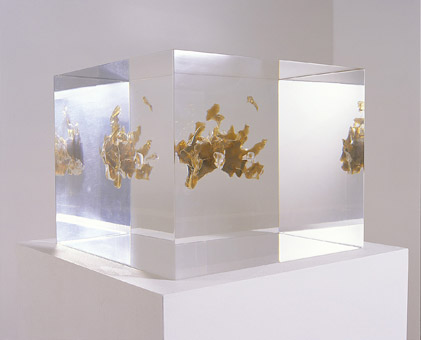
'SENSE' - Annie Cattrell (2001-2003)


As this is my first post I'll prattle on about my favourite piece of art about science. It's basically a series of five resin sculptures that illustrate the different parts of the brain that each of your senses activate (touch, smell, sight, hearing and taste). They're based on real brain scans from a real live volunteer.

According to the Wellcome Collection website (where you can see these sculptures) 'The elegant simplicity of the sculptures belies the complexity of the technology required to make them'.

Yadda, yadda, yadda.

I think they're not only interesting to look at but I really like the fact there's so much space within each block - nicely illustrating how specialised the different brain regions are.

I also like them because when you look at each one in turn you can visualise where the activated bits are in the brain. For example, you can see that with 'hearing' each side of the brain is activated by your ears, and with 'sight' the area at the back (your visual cortex) is activated. Neuroscientists often end up looking at a lot of 2D pictures of different parts of the brain 'lit up', which makes it easy to forget that what you're staring at is in fact a slice of a much bigger 3D object. I like this idea because it means that the sculptures have the power to feedback into the science they came from; creating a two-way dialogue.